Image created using advanced AI technology, professionally refined by the PornPlanner editorial team.
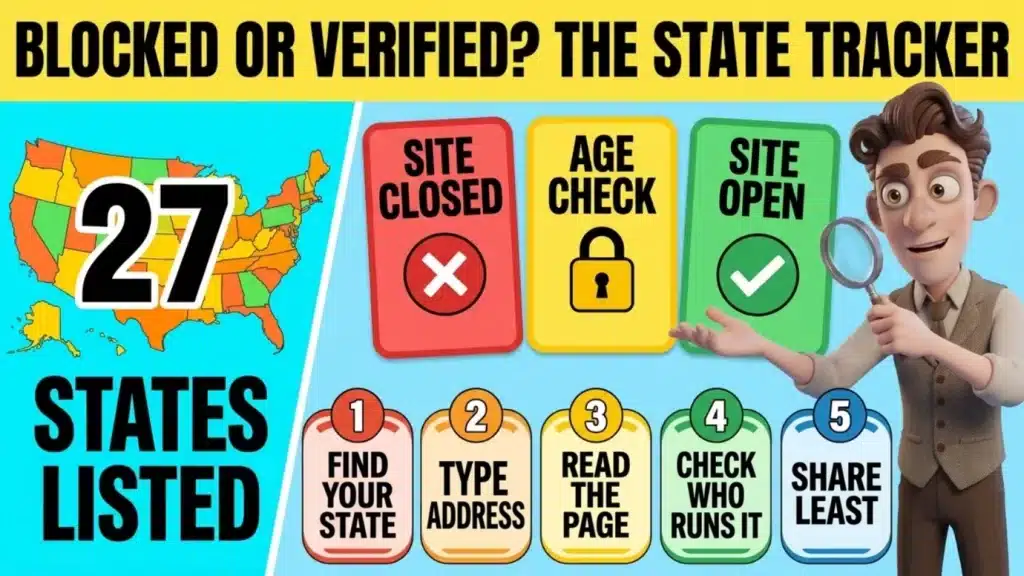
A state law does not ban porn. It tells websites to check ages, and each site decides whether to check or close. Find your state, read the rules and plan your night.
27
States Listed
3
Site Outcomes
5
Quick Checks
1
Date to Watch
Section 01
What is the difference between a blocked site and an age-verified one?
A blocked site is one that closes itself to a state, and an age-verified site is one that stays open there but asks you to prove you are 18 or older first. Both come from the same cause: a state law that puts the duty on the website, so the website chooses what to do.
Quick Definition
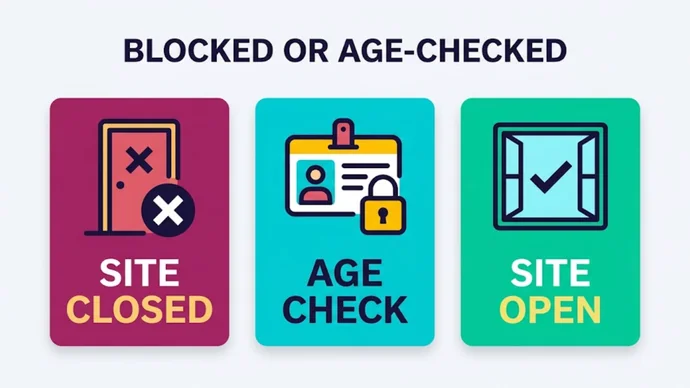
In a state with an age-verification law, a site ends up in one of 3 outcomes: closed to that state, open behind an age check, or open with no check shown.
Texas shows the first outcome. The state attorney general's office says Pornhub chose to shut down its site entirely in Texas instead of adding the age check, and how to watch porn in Texas and what the law changed walks through that state in depth.
That is why this tracker has two layers. The law is the same for every site in a state, and what each site does about it is its own decision.
The 3 outcomes a site can have in a state with a law
Section 02
What does a state age-verification law require?
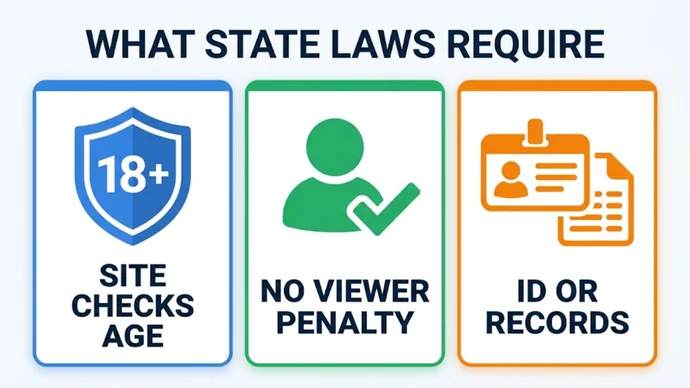
A state age-verification law requires a website that carries a large share of adult material to check that each visitor is 18 or older before the site shows that material. The laws share that core and differ in the details.
Texas, West Virginia and Missouri set the line at more than one-third of the site's content, Iowa at 33%, and Kansas at 25% of the pages viewed. The Louisiana-style laws use the words "a substantial portion".
How does a site prove your age?
Each law names the methods a site may use, and the most common are a government ID, a digital ID and transactional data, which means public or private records. Section 03 lists the methods state by state.
Who does the law apply to?
The law applies to the website, not to the viewer. In the summaries behind this tracker, the consequences fall on the site: private lawsuits, fines from the attorney general and, in Indiana, South Dakota and Tennessee, criminal charges against the operator. None of those summaries lists a penalty for the visitor.
What a state law asks of a website, and what it leaves out
Section 03
Which states require age verification?
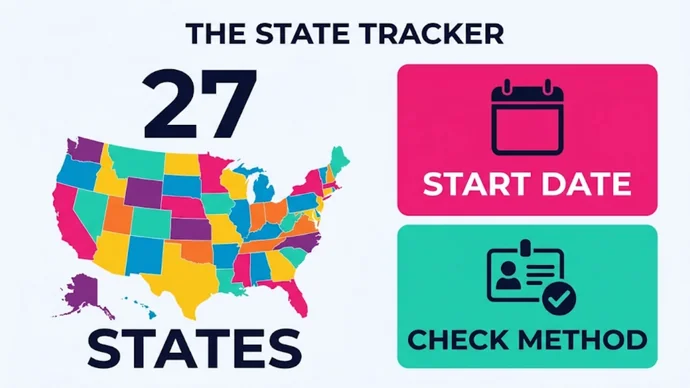
27 states require adult websites to verify age, and the table below lists each one with the date its law took effect and the ways the law lets a site check you. It follows the Free Speech Coalition's state-law page; a state that does not appear there is not listed on that page at the time of writing.
State
Law in effect since
How the check works
Alabama
Oct 1, 2024
Any commercially available method that gives reasonable assurance you are 18 or older
Arizona
Sep 26, 2025
Government ID or transactional data
Arkansas
Jul 31, 2023
Government ID or a commercial system that meets the IAL2 standard
Florida
Jan 1, 2025
A commercially reasonable method run by an independent third party based in the U.S.
Georgia
Jul 1, 2025
Digital ID, government ID or a commercial method that meets the IAL2 standard
Idaho
Jul 1, 2024
Digital ID, government ID or transactional data
Indiana
Jul 1, 2024 (enforceable Aug 16, 2024)
Mobile credential, an independent third-party service or transactional data
Iowa
Jul 1, 2026
Digital ID, transactional data or a method the attorney general approves
Kansas
Jul 1, 2024
A commercial database used for age checks or another method the attorney general approves
Kentucky
Jul 15, 2024
State ID, federal ID or transactional data
Louisiana
Jan 1, 2023
Government ID or transactional data
Mississippi
Jul 1, 2023
A commercial age-check system or a valid government ID
Missouri
Nov 30, 2025
Digital ID, government ID or transactional data
Montana
Jan 1, 2024
A commercial age-check system
Nebraska
Jul 18, 2024
Digital ID, a third-party service or transactional data
North Carolina
Jan 1, 2024
A commercial database used for age checks or another commercially reasonable method
North Dakota
Aug 1, 2025
Digital ID, government ID or transactional data
Ohio
Sep 30, 2025
A third-party system using photo ID or transactional data, a location check, and a new check every 2 years
Oklahoma
Nov 1, 2024
Digital ID, a third-party service or transactional data
South Carolina
Jan 1, 2025
The site must keep minors out, and people can sue sites that do not
South Dakota
Jul 1, 2025
Driver license or ID, bank account information, an 18+ debit or credit card, or another reliable method
Tennessee
Jan 1, 2025 (enforceable Jan 13, 2025)
Government ID with a live photo match, or transactional data, with a new check after each 60-minute session
Texas
Sep 1, 2023 (court-delayed to Sep 19, 2023)
Digital ID, government ID or transactional data
Utah
May 3, 2023
A commercial age-check system
Virginia
Jul 1, 2023
A commercial age-check system
West Virginia
Jun 12, 2026
Digital ID, government ID or transactional data
Wyoming
Jul 1, 2025
U.S. driver license or ID, passport, military or tribal ID, or an 18+ credit or debit card
Indiana, Tennessee and Texas each had a court step between the start date and the day the law could be enforced, which is why they show two dates.
The table lists laws, not sites. Whether a site closes, checks ages or shows nothing in a state is the site's decision, so you read it on the site.
27 states on the tracker, each with a start date and a check method
Section 04
What changes next, including on January 1?
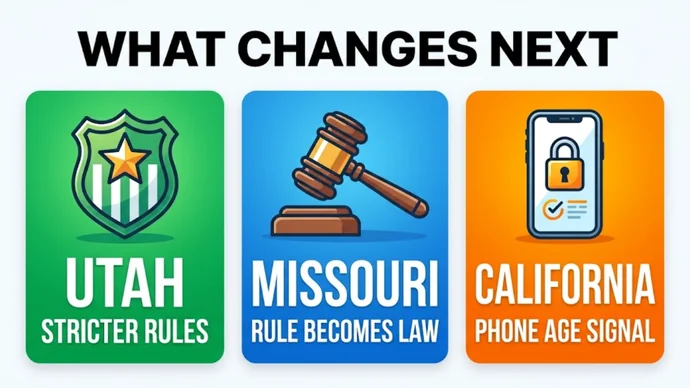
Three changes are on the calendar or just landed: Utah's stricter enforcement, Missouri's rule becoming a law, and California's phone-level age signal that starts on January 1, 2027. This table sets them side by side.
Where
What changes
When
Utah
SB 73 moves enforcement to the state Division of Consumer Protection and makes companies liable for checking users located in Utah, even when a user masks their location
May 6, 2026
Missouri
HB 1839 turns the existing age-check rule into a law, adds a fine of up to $250,000 if a minor gets in, and requires a third party to run the check
Approved Jul 9, 2026
California
The Digital Age Assurance Act has the operating system ask for a birth date or age at account setup and pass an age bracket to apps
Starts Jan 1, 2027
The California law works through your phone or computer and its app store, so it is a different thing from the website checks in section 03. AB 1856, approved on September 10, 2026, says the age signal goes to a covered app store or an app developer.
For you, the practical part is simple: a state's rules change by law, so look up your state in section 03 again whenever a headline says a new law has started.
Three changes to watch: Utah, Missouri and California
Section 05
What should you check before you open a site?
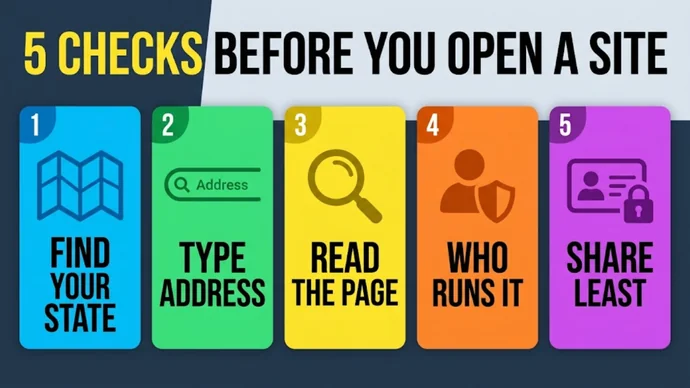
Before you open a site, run 5 quick checks: they take your state, the site's address and what the page shows, in that order. They run from the broadest question, your state, to the narrowest one, what the page asks of you.
Before you open a site
Find your state: look it up in section 03 and note the methods it lists.
Type the address yourself: do not follow an ad or a message to the site.
Read what the page shows: a closed notice, an age check or a normal page is the site's status for tonight.
Find who runs the check: the site itself or a named third party, and what it says about keeping your data.
Share the least, or leave: pick the method that asks for the least, and leave at anything outside the methods your state lists.
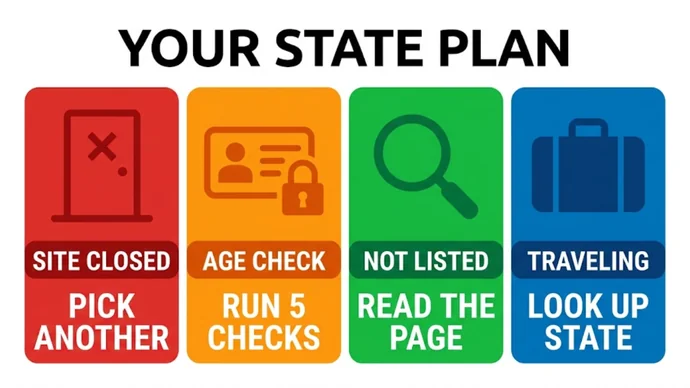
You will meet one of 4 situations, and each has one sensible move. This table pairs them.
Situation
Do this
Why it helps
A site you use is closed in your state
Pick another site you have already checked
The company made the closing, so there is nothing for you to fix
A site shows an age check
Run the 5 checks, then decide
You decide with the facts in front of you
Your state is not in the table
Open the site and read what it shows
The table is a snapshot, and the page shows what the site does tonight
You are in another state tonight
Look up that state before you open a site
Each law is written for its own state, and Ohio's, for one, has the site check whether the visitor is located in Ohio
Which mistakes cost the most?
5 habits cause most of the trouble. This table pairs each one with the fix.
Mistake
Do this instead
Treating an old headline as today's status
Open the site and read what it shows
Assuming a law closes every site
Remember that each site chooses to close, check or neither
Uploading an ID to the first page that asks
Check the address and who runs the check
Believing a viewer can be fined
Read section 02: the consequences fall on the site
Tapping an "unblock" ad
Close it and go back to the sites you know
Ads that promise to unblock a site are the most common trap, and how to block porn ads and pop-ups shows how to keep them off your screen.
Four situations and one move for each
Section 07
Frequently Asked Questions
Is porn banned in the United States?
No, the 27 laws in the tracker are age-check laws for websites, and they do not ban adult content. A site that closes to a state does so by its own decision.
Can you get in trouble for watching porn in a state with an age-check law?
Not under the laws summarized in section 02, because they put the consequences on the website. The visitor's part is to pass the check on the sites that ask for one.
Is Pornhub blocked in my state?
Texas is the state where an official source says so: the attorney general's office says Pornhub chose to shut down its site entirely there. For any other state, open the site and read what it shows.
Does a private window skip the age check?
No, a private window only keeps the visit out of your browser history on your own device. The site still decides who gets in, and what incognito mode hides and what it doesn't lays out who can still see your visit.
Does a VPN change my state's law?
No, a VPN does not change what a law asks of a website, and Utah's SB 73 even makes companies liable for checking users located in Utah when a user masks their location. This guide does not cover VPNs, and a VPN is another company that handles your traffic.
Section 08
Key Takeaways
A state law sets the rule for the website, and each site decides whether it closes, checks ages or does neither, so your plan starts with your state and ends on the site's own page.
Remember
The duty is the website's: the laws in the tracker put the consequences on the site, not on the viewer.
27 states are on the tracker: look yours up in section 03, with its start date and check method.
The table lists laws, not sites: read what a site shows before you do anything else.
Run the 5 checks before you open a site, and leave at anything outside your state's methods.
US-based web developer and creator of PornPlanner.com. Every part of the site is built and maintained with usability, speed and reliability in mind — code first, hype never.
Curated by experts and updated regularly — our directory covers free porn tubes, premium porn sites, live cams, AI porn and dozens of other categories.